Checkout Capability
- Capability Name:
dev.ucp.shopping.checkout
Overview
Allows platforms to facilitate checkout sessions. The checkout has to be finalized manually by the user through a trusted UI unless the AP2 Mandates extension is supported.
The business remains the Merchant of Record (MoR), and they don't need to become PCI DSS compliant to accept card payments through this Capability.
Flow overview
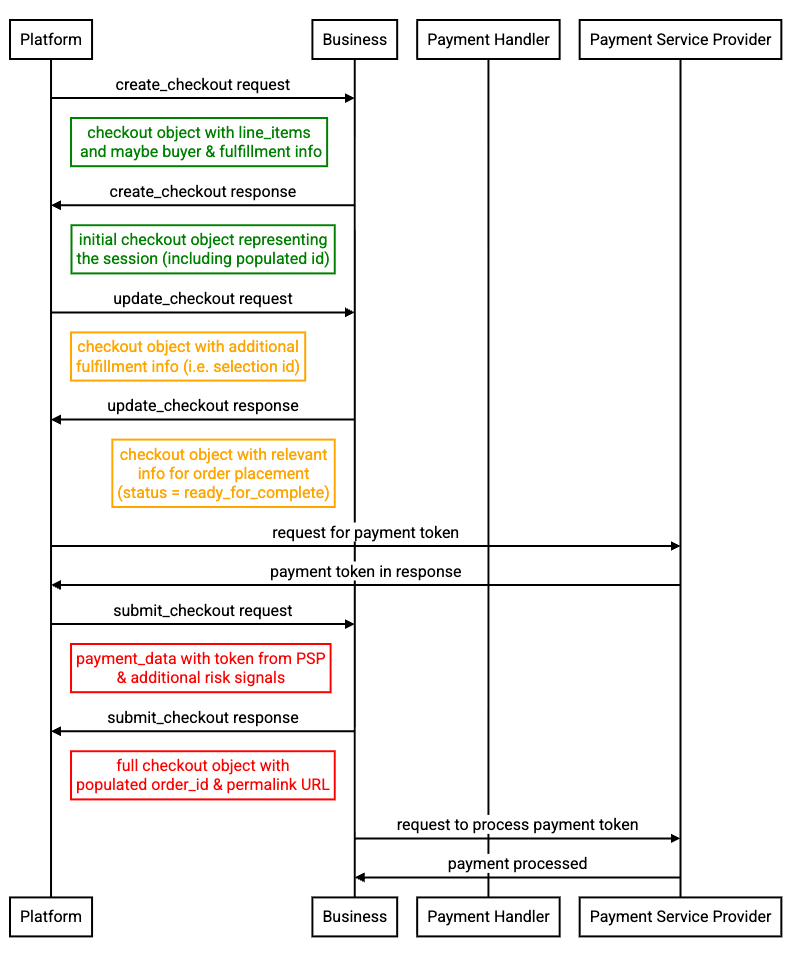
Payments
Payment handlers are discovered from the business's UCP profile at
/.well-known/ucp and checkout.ucp.payment_handlers. The handlers define
the processing specifications for collecting payment instruments
(e.g., Google Pay, Shop Pay). When the buyer submits payment, the platform
populates the payment.instruments array with the collected instrument data.
The payment object is optional on checkout creation and may be omitted for
use cases that don't require payment processing (e.g., quote generation, cart
management).
Fulfillment
Fulfillment is modelled as an extension in UCP to account for diverse use cases.
Fulfillment is optional in the checkout object. This is done to enable a platform to perform checkout for digital goods without needing to furnish fulfillment details more relevant for physical goods.
Checkout Status Lifecycle
The checkout status field indicates the current phase of the session and
determines what action is required next. The business sets the status; the
platform receives messages indicating what's needed to progress.
       +------------+                         +---------------------+
       | incomplete |<----------------------->| requires_escalation |
       +-----+------+                         |   (buyer handoff    |
             |                                |  via continue_url)  |
             | all info collected             +----------+----------+
             v                                           |
    +------------------+                                 |
    |ready_for_complete|                                 |
    |                  |                                 |
    | (platform can    |                                 | continue_url
    | call Complete    |                                 |
    |   Checkout)      |                                 |
    +--------+---------+                                 |
             |                                           |
             | Complete Checkout                         |
             v                                           |
   +--------------------+                                |
   |complete_in_progress|                                |
   +---------+----------+                                |
             |                                           |
             +-----------------------+-------------------+
                                     v
                               +-------------+
                               |  completed  |
                               +-------------+

                               +-------------+
                               |  canceled   |
                               +-------------+
          (session invalid/expired - can occur from any state)
Status Values
-
incomplete: Checkout session is missing required information or has issues that need resolution. Platform should inspectmessagesarray for context and should attempt to resolve via Update Checkout. -
requires_escalation: Checkout session requires information that cannot be provided via API, or buyer input is required. Platform should inspectmessagesto understand what's needed (see Error Handling below). If anyrecoverableerrors exist, resolve those first. Then hand off to buyer viacontinue_url. -
ready_for_complete: Checkout session has all necessary information and platform can finalize programmatically. Platform can call Complete Checkout. -
complete_in_progress: Business is processing the Complete Checkout request. -
completed: Order placed successfully. -
canceled: Checkout session is invalid or expired. Platform should start a new checkout session if needed.
Error Handling
The messages array contains errors, warnings, and informational messages
about the checkout state. Error messages include a severity field that
reflects the resource state and recommended action. When ucp.status
is "success", a resource is returned and severity indicates the
recommended action. When ucp.status is "error", no valid resource
exists — severity is unrecoverable:
| Severity | Meaning | Platform Action |
|---|---|---|
recoverable |
Platform can resolve by modifying inputs via API | Update resource and retry |
requires_buyer_input |
Business requires input not available via API | Hand off via continue_url |
requires_buyer_review |
Buyer review and authorization is required | Hand off via continue_url |
unrecoverable |
No resource exists to act on | Retry with new resource or inputs, or hand off via continue_url |
Errors with requires_* severity contribute to status: requires_escalation.
Both result in buyer handoff, but represent different checkout states.
requires_buyer_inputmeans the checkout is incomplete — the business requires information their API doesn't support collecting programmatically.requires_buyer_reviewmeans the checkout is complete — but policy, regulatory, or entitlement rules require buyer authorization before order placement (e.g., high-value order approval, first-purchase policy).
When the business cannot create a new resource or the requested resource
no longer exists, the response contains ucp.status: "error" with
messages describing the failure — no resource is included in the
response body. Error responses MUST use severity: "unrecoverable".
For example, a business may reject a create checkout request where all
items are unavailable:
{
  "ucp": { "version": "2026-01-11", "status": "error" },
  "messages": [
    {
      "type": "error",
      "code": "out_of_stock",
      "content": "All requested items are currently out of stock",
      "severity": "unrecoverable"
    }
  ],
  "continue_url": "https://merchant.com/"
}
See REST and MCP binding examples.
Error Processing Algorithm
When status is incomplete or requires_escalation, platforms should process
errors as a prioritized stack. The example below illustrates a checkout with
three error types: a recoverable error (invalid phone), a buyer input
requirement (delivery scheduling), and a review requirement (high-value order).
The latter two require handoff and serve as explicit signals to the platform.
Businesses SHOULD surface such messages as early as possible, and platforms
SHOULD prioritize resolving recoverable errors before initiating handoff.
{
  "status": "requires_escalation",
  "messages": [
    {
      "type": "error",
      "code": "invalid_phone",
      "severity": "recoverable",
      "content": "Phone number format is invalid"
    },
    {
      "type": "error",
      "code": "schedule_delivery",
      "severity": "requires_buyer_input",
      "content": "Select delivery window for your purchase"
    },
    {
      "type": "error",
      "code": "high_value_order",
      "severity": "requires_buyer_review",
      "content": "Orders over $500 require additional verification"
    }
  ]
}
Example error processing algorithm:
GIVEN response with messages array

IF ucp.status = "error"
  -- No resource exists; severity is unrecoverable
  RETRY with new resource or inputs, or hand off via continue_url
  RETURN

FILTER errors FROM messages WHERE type = "error"

PARTITION errors INTO
  recoverable           WHERE severity = "recoverable"
  requires_buyer_input  WHERE severity = "requires_buyer_input"
  requires_buyer_review WHERE severity = "requires_buyer_review"

IF recoverable is not empty
  FOR EACH error IN recoverable
    ATTEMPT to fix error (e.g., reformat phone number)
  CALL Update Checkout
  RETURN and re-evaluate response

IF requires_buyer_input is not empty
  handoff_context = "incomplete, additional input from buyer is required"
ELSE IF requires_buyer_review is not empty
  handoff_context = "ready for final review by the buyer"
Standard Errors
Standard errors are standardized error codes that platforms are expected to handle with specific, appropriate UX rather than generic error treatment.
| Code | Description |
|---|---|
out_of_stock |
Specific item or variant is unavailable |
item_unavailable |
Item cannot be purchased (e.g. delisted) |
address_undeliverable |
Cannot deliver to the provided address |
payment_failed |
Payment processing failed |
Businesses SHOULD mark standard errors with severity: recoverable to
signal that platforms should provide appropriate UX (out-of-stock messaging,
address validation prompts, payment method changes) rather than generic error
messages or deferring to checkout completion.
Example: out_of_stock requires specific upfront UX, whereas
payment_required can be handled generically at submission.
Continue URL
The continue_url field enables checkout handoff from platform to business UI,
allowing the buyer to continue and finalize the checkout session.
Availability
Businesses MUST provide continue_url when returning status =
requires_escalation. For all other non-terminal statuses (incomplete,
ready_for_complete, complete_in_progress), businesses SHOULD provide
continue_url. For terminal states (completed, canceled), continue_url
SHOULD be omitted.
Format
The continue_url MUST be an absolute HTTPS URL and SHOULD preserve
checkout state for seamless handoff. Businesses MAY implement state
preservation using either approach:
Server-Side State (Recommended)
An opaque URL backed by server-side checkout state:
- Server maintains checkout state tied to
checkout_id - Simple, secure, recommended for most implementations
- URL lifetime typically tied to
expires_at
Checkout Permalink
A stateless URL that encodes checkout state directly, allowing reconstruction without server-side persistence. Businesses SHOULD implement support for this format to facilitate checkout handoff and accelerated entry—for example, a platform can prefill checkout state when initiating a buy-now flow.
Note: Checkout permalinks are a REST-specific construct that extends the REST transport binding. Accessing a permalink returns a redirect to the checkout UI or renders the checkout page directly.
Guidelines
(In addition to the overarching guidelines)
Platform
- MAY engage an agent to facilitate the checkout session (e.g. add items to the checkout session, select fulfillment address). However, the agent must hand over the checkout session to a trusted and deterministic UI for the user to review the checkout details and place the order.
- MAY send the user from the trusted, deterministic UI back to the agent at any time. For example, when the user decides to exit the checkout screen to keep adding items to the cart.
- MAY provide agent context when the platform indicates that the request was done by an agent.
- MUST use
continue_urlwhen checkout status isrequires_escalation. - MAY use
continue_urlto hand off to business UI in other situations. - When performing handoff, SHOULD prefer business-provided
continue_urlover platform-constructed checkout permalinks.
Business
- MUST send a confirmation email after the checkout has been completed.
- SHOULD provide accurate error messages.
- Logic handling the checkout sessions MUST be deterministic.
- MUST provide
continue_urlwhen returningstatus=requires_escalation. - MUST include at least one message with
severityofrequires_buyer_inputorrequires_buyer_reviewwhen returningstatus=requires_escalation. - SHOULD provide
continue_urlin all non-terminal checkout responses. - After a checkout session reaches the state "completed", it is considered immutable.
Capability Schema Definition 
| Name | Type | Required | Description |
|---|---|---|---|
| ucp | Ucp Response Checkout Schema | Yes | Protocol metadata for discovery profiles and responses. Uses slim schema pattern with context-specific required fields. |
| id | string | Yes | Unique identifier of the checkout session. |
| line_items | Array[Line Item Response] | Yes | List of line items being checked out. |
| buyer | Buyer | No | Representation of the buyer. |
| status | string | Yes | Checkout state indicating the current phase and required action. See Checkout Status lifecycle documentation for state transition details. Enum: incomplete, requires_escalation, ready_for_complete, complete_in_progress, completed, canceled |
| currency | string | Yes | ISO 4217 currency code reflecting the merchant's market determination. Derived from address, context, and geo IP—buyers provide signals, merchants determine currency. |
| totals | Array[Total Response] | Yes | Different cart totals. |
| messages | Array[Message] | No | List of messages with error and info about the checkout session state. |
| links | Array[Link] | Yes | Links to be displayed by the platform (Privacy Policy, TOS). Mandatory for legal compliance. |
| expires_at | string | No | RFC 3339 expiry timestamp. Default TTL is 6 hours from creation if not sent. |
| continue_url | string | No | URL for checkout handoff and session recovery. MUST be provided when status is requires_escalation. See specification for format and availability requirements. |
| payment | Payment | No | Payment configuration containing handlers. |
| order | Order Confirmation | No | Details about an order created for this checkout session. |
Operations
The Checkout capability defines the following logical operations.
| Operation | Description |
|---|---|
| Create Checkout | Initiates a new checkout session. Called as soon as a user adds an item to a cart. |
| Get Checkout | Retrieves the current state of a checkout session. |
| Update Checkout | Updates a checkout session. |
| Complete Checkout | Finalizes the checkout and places the order. |
| Cancel Checkout | Cancels a checkout session. |
Create Checkout
To be invoked by the platform when the user has expressed purchase intent (e.g., click on Buy) to initiate the checkout session with the item details.
Recommendation: To minimize discrepancies and a streamlined user experience, product data (price/title etc.) provided by the business through the feeds SHOULD match the actual attributes returned in the response.
Inputs
| Name | Type | Required | Description |
|---|---|---|---|
| line_items | Array[Line Item] | Yes | List of line items being checked out. |
| buyer | Buyer | No | Representation of the buyer. |
| context | Context | No | Provisional buyer signals for relevance and localization—not authoritative data. Businesses SHOULD use these values when verified inputs (e.g., shipping address) are absent, and MAY ignore or down-rank them if inconsistent with higher-confidence signals (authenticated account, risk detection) or regulatory constraints (export controls). Eligibility and policy enforcement MUST occur at checkout time using binding transaction data. Context SHOULD be non-identifying and can be disclosed progressively—coarse signals early, finer resolution as the session progresses. Higher-resolution data (shipping address, billing address) supersedes context. |
| payment | Payment | No | Payment configuration containing handlers. |
Output
This object MUST be one of the following types: Checkout, Error Response.
Get Checkout
It provides the latest state of the checkout resource. After cancellation or completion it is up to the business on what to return (i.e this can be a long lived state or expire after a particular TTL - resulting in a 'not found' error). From the platform there is no specific enforcement for a TTL of the checkout.
The platform will honor the TTL provided by the business via expires_at at the
time of checkout session creation.
Inputs
| Name | Type | Required | Description |
|---|---|---|---|
| id | string | Yes | The unique identifier of the checkout session.Defined in path. |
Output
This object MUST be one of the following types: Checkout, Error Response.
Update Checkout
Performs a full replacement of the checkout resource. The platform is REQUIRED to send the entire checkout resource containing any data updates to write-only data fields. The resource provided in the request will replace the existing checkout session state on the business side.
Inputs
| Name | Type | Required | Description |
|---|---|---|---|
| id | string | Yes | The unique identifier of the checkout session.Defined in path. |
| id | string | Yes | Unique identifier of the checkout session. |
| line_items | Array[Line Item] | Yes | List of line items being checked out. |
| buyer | Buyer | No | Representation of the buyer. |
| context | Context | No | Provisional buyer signals for relevance and localization—not authoritative data. Businesses SHOULD use these values when verified inputs (e.g., shipping address) are absent, and MAY ignore or down-rank them if inconsistent with higher-confidence signals (authenticated account, risk detection) or regulatory constraints (export controls). Eligibility and policy enforcement MUST occur at checkout time using binding transaction data. Context SHOULD be non-identifying and can be disclosed progressively—coarse signals early, finer resolution as the session progresses. Higher-resolution data (shipping address, billing address) supersedes context. |
| payment | Payment | No | Payment configuration containing handlers. |
Output
This object MUST be one of the following types: Checkout, Error Response.
Complete Checkout
This is the final checkout placement call. To be invoked when the user has
committed to pay and place an order for the chosen items. The response of this
call is the checkout object with the order field populated in it. The returned
order provides necessary identifiers, such as id and permalink_url,
that can be used to reference the full state of the placed order.
At the time of order persistence, fields from Checkout MAY be used
to construct the order representation (i.e. information like line_items,
fulfillment will be used to create the initial order representation).
After this call, other details will be updated through subsequent events as the order, and its associated items, moves through the supply chain.
Inputs
| Name | Type | Required | Description |
|---|---|---|---|
| id | string | Yes | The unique identifier of the checkout session.Defined in path. |
| payment | Payment | Yes | Payment configuration containing handlers. |
| risk_signals | object | No | Key-value pairs of risk signals. |
Output
This object MUST be one of the following types: Checkout, Error Response.
Cancel Checkout
This operation will be used to cancel a checkout session, if it can be canceled.
If the checkout session cannot be canceled (e.g. checkout session is
already canceled or completed), then businesses SHOULD send back an error
indicating the operation is not allowed. Any checkout session with a status
that is not equal to completed or canceled SHOULD be cancelable.
Inputs
| Name | Type | Required | Description |
|---|---|---|---|
| id | string | Yes | The unique identifier of the checkout session.Defined in path. |
Output
This object MUST be one of the following types: Checkout, Error Response.
Transport Bindings
The abstract operations above are bound to specific transport protocols as defined below:
- REST Binding: RESTful API mapping using standard HTTP verbs and JSON payloads.
- MCP Binding: Model Context Protocol mapping for agentic interaction.
- A2A Binding: Agent-to-Agent Protocol mapping for agentic interactions.
- Embedded Checkout Binding: JSON-RPC for powering embedded checkout.
Entities
Buyer
| Name | Type | Required | Description |
|---|---|---|---|
| first_name | string | No | First name of the buyer. |
| last_name | string | No | Last name of the buyer. |
| string | No | Email of the buyer. | |
| phone_number | string | No | E.164 standard. |
Context
Context signals are provisional—not authoritative data. Businesses SHOULD use these values when verified inputs (e.g., shipping address) are absent, and MAY ignore or down-rank them if inconsistent with higher-confidence signals (authenticated account, risk detection) or regulatory constraints (export controls). Eligibility and policy enforcement MUST occur at checkout time using binding transaction data.
| Name | Type | Required | Description |
|---|---|---|---|
| address_country | string | No | The country. Recommended to be in 2-letter ISO 3166-1 alpha-2 format, for example "US". For backward compatibility, a 3-letter ISO 3166-1 alpha-3 country code such as "SGP" or a full country name such as "Singapore" can also be used. Optional hint for market context (currency, availability, pricing)—higher-resolution data (e.g., shipping address) supersedes this value. |
| address_region | string | No | The region in which the locality is, and which is in the country. For example, California or another appropriate first-level Administrative division. Optional hint for progressive localization—higher-resolution data (e.g., shipping address) supersedes this value. |
| postal_code | string | No | The postal code. For example, 94043. Optional hint for regional refinement—higher-resolution data (e.g., shipping address) supersedes this value. |
| intent | string | No | Background context describing buyer's intent (e.g., 'looking for a gift under $50', 'need something durable for outdoor use'). Informs relevance, recommendations, and personalization. |
| language | string | No | Preferred language for content. Use IETF BCP 47 language tags (e.g., 'en', 'fr-CA', 'zh-Hans'). For REST, equivalent to Accept-Language header—platforms SHOULD fall back to Accept-Language when this field is absent; when provided, overrides Accept-Language. Businesses MAY return content in a different language if unavailable. |
| currency | string | No | Preferred currency (ISO 4217, e.g., 'EUR', 'USD'). Businesses determine presentment currency from context and authoritative signals; this hint MAY inform selection in multi-currency markets. Also serves as the denomination for price filter values — platforms SHOULD include this field when sending price filters. Response prices include explicit currency confirming the resolution. |
Fulfillment Option
| Name | Type | Required | Description |
|---|---|---|---|
| id | string | Yes | Unique fulfillment option identifier. |
| title | string | Yes | Short label (e.g., 'Express Shipping', 'Curbside Pickup'). |
| description | string | No | Complete context for buyer decision (e.g., 'Arrives Dec 12-15 via FedEx'). |
| carrier | string | No | Carrier name (for shipping). |
| earliest_fulfillment_time | string | No | Earliest fulfillment date. |
| latest_fulfillment_time | string | No | Latest fulfillment date. |
| totals | Array[object] | Yes | Fulfillment option totals breakdown. |
Item
Item Create Request
| Name | Type | Required | Description |
|---|---|---|---|
| id | string | Yes | The product identifier, often the SKU, required to resolve the product details associated with this line item. Should be recognized by both the Platform, and the Business. |
Item Update Request
| Name | Type | Required | Description |
|---|---|---|---|
| id | string | Yes | The product identifier, often the SKU, required to resolve the product details associated with this line item. Should be recognized by both the Platform, and the Business. |
Item
| Name | Type | Required | Description |
|---|---|---|---|
| id | string | Yes | The product identifier, often the SKU, required to resolve the product details associated with this line item. Should be recognized by both the Platform, and the Business. |
| title | string | Yes | Product title. |
| price | Amount | Yes | Unit price in ISO 4217 minor units. |
| image_url | string | No | Product image URI. |
Line Item
Line Item Create Request
| Name | Type | Required | Description |
|---|---|---|---|
| item | Item | Yes | |
| quantity | integer | Yes | Quantity of the item being purchased. |
Line Item Update Request
| Name | Type | Required | Description |
|---|---|---|---|
| id | string | No | |
| item | Item | Yes | |
| quantity | integer | Yes | Quantity of the item being purchased. |
| parent_id | string | No | Parent line item identifier for any nested structures. |
Line Item
| Name | Type | Required | Description |
|---|---|---|---|
| id | string | Yes | |
| item | Item | Yes | |
| quantity | integer | Yes | Quantity of the item being purchased. |
| totals | Array[Total] | Yes | Line item totals breakdown. |
| parent_id | string | No | Parent line item identifier for any nested structures. |
Link
| Name | Type | Required | Description |
|---|---|---|---|
| type | string | Yes | Type of link. Well-known values: privacy_policy, terms_of_service, refund_policy, shipping_policy, faq. Consumers SHOULD handle unknown values gracefully by displaying them using the title field or omitting the link. |
| url | string | Yes | The actual URL pointing to the content to be displayed. |
| title | string | No | Optional display text for the link. When provided, use this instead of generating from type. |
Well-Known Link Types
Businesses SHOULD provide all relevant links for the transaction. The following are the recommended well-known types:
| Type | Description |
|---|---|
privacy_policy |
Link to the business's privacy policy |
terms_of_service |
Link to the business's terms of service |
refund_policy |
Link to the business's refund policy |
shipping_policy |
Link to the business's shipping policy |
faq |
Link to the business's frequently asked questions |
Businesses MAY define custom types for domain-specific needs. Platforms
SHOULD handle unknown types gracefully by displaying them using the title
field or omitting them.
Message
This object MUST be one of the following types: Message Error, Message Warning, Message Info.
Message Error
| Name | Type | Required | Description |
|---|---|---|---|
| type | string | Yes | Constant = error. Message type discriminator. |
| code | Error Code | Yes | Error code identifying the type of error. Standard errors are defined in specification (see examples), and have standardized semantics; freeform codes are permitted. |
| path | string | No | RFC 9535 JSONPath to the component the message refers to (e.g., $.items[1]). |
| content_type | string | No | Content format, default = plain. Enum: plain, markdown |
| content | string | Yes | Human-readable message. |
| severity | string | Yes | Reflects the resource state and recommended action. 'recoverable': platform can resolve by modifying inputs and retrying via API. 'requires_buyer_input': merchant requires information their API doesn't support collecting programmatically (checkout incomplete). 'requires_buyer_review': buyer must authorize before order placement due to policy, regulatory, or entitlement rules. 'unrecoverable': no valid resource exists to act on, retry with new resource or inputs. Errors with 'requires_' severity contribute to 'status: requires_escalation'. Enum:* recoverable, requires_buyer_input, requires_buyer_review, unrecoverable |
Error Code
Error code identifying the type of error. Standard errors are defined in specification (see examples), and have standardized semantics; freeform codes are permitted.
Message Info
| Name | Type | Required | Description |
|---|---|---|---|
| type | string | Yes | Constant = info. Message type discriminator. |
| path | string | No | RFC 9535 JSONPath to the component the message refers to. |
| code | string | No | Info code for programmatic handling. |
| content_type | string | No | Content format, default = plain. Enum: plain, markdown |
| content | string | Yes | Human-readable message. |
Message Warning
| Name | Type | Required | Description |
|---|---|---|---|
| type | string | Yes | Constant = warning. Message type discriminator. |
| path | string | No | JSONPath (RFC 9535) to related field (e.g., $.line_items[0]). |
| code | string | Yes | Warning code. Machine-readable identifier for the warning type (e.g., final_sale, prop65, fulfillment_changed, age_restricted, etc.). |
| content | string | Yes | Human-readable warning message that MUST be displayed. |
| content_type | string | No | Content format, default = plain. Enum: plain, markdown |
Payment
| Name | Type | Required | Description |
|---|---|---|---|
| instruments | Array[Payment Instrument Selected Payment Instrument] | No | The payment instruments available for this payment. Each instrument is associated with a specific handler via the handler_id field. Handlers can extend the base payment_instrument schema to add handler-specific fields. |
Selected Payment Instrument
| Name | Type | Required | Description |
|---|---|---|---|
| id | string | Yes | A unique identifier for this instrument instance, assigned by the platform. |
| handler_id | string | Yes | The unique identifier for the handler instance that produced this instrument. This corresponds to the 'id' field in the Payment Handler definition. |
| type | string | Yes | The broad category of the instrument (e.g., 'card', 'tokenized_card'). Specific schemas will constrain this to a constant value. |
| billing_address | object | No | The billing address associated with this payment method. |
| credential | object | No | The base definition for any payment credential. Handlers define specific credential types. |
| display | object | No | Display information for this payment instrument. Each payment instrument schema defines its specific display properties, as outlined by the payment handler. |
| selected | boolean | No | Whether this instrument is selected by the user. |
Payment Credential
| Name | Type | Required | Description |
|---|---|---|---|
| type | string | Yes | The credential type discriminator. Specific schemas will constrain this to a constant value. |
Postal Address
| Name | Type | Required | Description |
|---|---|---|---|
| extended_address | string | No | An address extension such as an apartment number, C/O or alternative name. |
| street_address | string | No | The street address. |
| address_locality | string | No | The locality in which the street address is, and which is in the region. For example, Mountain View. |
| address_region | string | No | The region in which the locality is, and which is in the country. Required for applicable countries (i.e. state in US, province in CA). For example, California or another appropriate first-level Administrative division. |
| address_country | string | No | The country. Recommended to be in 2-letter ISO 3166-1 alpha-2 format, for example "US". For backward compatibility, a 3-letter ISO 3166-1 alpha-3 country code such as "SGP" or a full country name such as "Singapore" can also be used. |
| postal_code | string | No | The postal code. For example, 94043. |
| first_name | string | No | Optional. First name of the contact associated with the address. |
| last_name | string | No | Optional. Last name of the contact associated with the address. |
| phone_number | string | No | Optional. Phone number of the contact associated with the address. |
Response
| Name | Type | Required | Description |
|---|---|---|---|
| version | string | Yes | Entity version in YYYY-MM-DD format. |
| spec | string | No | URL to human-readable specification document. |
| schema | string | No | URL to JSON Schema defining this entity's structure and payloads. |
| id | string | No | Unique identifier for this entity instance. Used to disambiguate when multiple instances exist. |
| config | object | No | Entity-specific configuration. Structure defined by each entity's schema. |
| extends | OneOf[] | No | Parent capability(s) this extends. Present for extensions, absent for root capabilities. Use array for multi-parent extensions. |
Total
Total
| Name | Type | Required | Description |
|---|---|---|---|
| type | string | Yes | Type of total categorization. Enum: items_discount, subtotal, discount, fulfillment, tax, fee, total |
| display_text | string | No | Text to display against the amount. Should reflect appropriate method (e.g., 'Shipping', 'Delivery'). |
| amount | Amount | Yes | If type == total, sums subtotal - discount + fulfillment + tax + fee. Should be >= 0. Amount in ISO 4217 minor units. |
UCP Response Checkout
| Name | Type | Required | Description |
|---|---|---|---|
| version | string | Yes | UCP version in YYYY-MM-DD format. |
| status | string | No | Application-level status of the UCP operation. Enum: success, error |
| services | object | No | Service registry keyed by reverse-domain name. |
| capabilities | object | No | Capability registry keyed by reverse-domain name. |
| payment_handlers | object | No | Payment handler registry keyed by reverse-domain name. |
| services | any | No | |
| capabilities | any | No | |
| payment_handlers | any | Yes |
Order Confirmation
| Name | Type | Required | Description |
|---|---|---|---|
| id | string | Yes | Unique order identifier. |
| permalink_url | string | Yes | Permalink to access the order on merchant site. |
Error Response 
| Name | Type | Required | Description |
|---|---|---|---|
| ucp | any | Yes | UCP protocol metadata. Status MUST be 'error' for error response. |
| messages | Array[Message] | Yes | Array of messages describing why the operation failed. |
| continue_url | string | No | URL for buyer handoff or session recovery. |